

Have you ever picked up a product in a store or browsed an online shopping website and wondered how its final price was decided? Whether you’re buying groceries, electronics, clothing, or household essentials, the amount displayed on the price tag is known as the retail price. Understanding the meaning retail price is important not only for shoppers who want to make informed purchasing decisions but also for business owners who need to price products competitively while maintaining healthy profits.
Retail pricing plays a major role in every business, from small local shops to global brands. It influences customer buying decisions, affects business revenue, and helps companies position themselves in competitive markets. While many people think retail price is simply the amount customers pay, it actually reflects several factors, including production costs, operating expenses, market demand, competitor pricing, and the retailer’s desired profit margin.
In this comprehensive guide, you’ll learn the complete meaning of retail price, how it is calculated, why it matters, the difference between retail price and wholesale price, common pricing strategies, and practical examples from everyday life. Whether you’re a business owner, a student, or simply curious about how product pricing works, this guide will give you a clear understanding of one of the most important concepts in retail and commerce.
What Is the Meaning Retail Price?
The meaning retail price refers to the final amount a customer pays when purchasing a product from a retailer. It is the price displayed on a product’s label, shelf, or online listing before any discounts, coupons, or promotional offers are applied. This price includes not only the original cost of the product but also the retailer’s operating expenses and profit margin, making it the amount the business expects to receive from each sale.
Retail price serves as the bridge between businesses and consumers. Manufacturers create products and usually sell them to wholesalers or retailers at lower prices. Retailers then add a markup to cover expenses such as rent, employee salaries, marketing, utilities, inventory management, taxes, and other operational costs. The final figure customers see is the retail price, which represents the product’s market value in a retail environment.
For consumers, retail price provides transparency by clearly showing how much they need to pay before making a purchase. For businesses, it represents a carefully planned pricing decision that balances profitability with competitiveness. Setting the right retail price requires understanding customer expectations, analyzing competitors, and evaluating market trends. A price that is too high may discourage buyers, while a price that is too low could reduce profits or even create doubts about product quality.
Retail Price at a Glance
| Term | Explanation |
| Definition | Final selling price paid by customers |
| Paid By | Consumers |
| Includes | Product cost, operating expenses, and profit |
| Used By | Retail stores, supermarkets, online businesses, and eCommerce platforms |
| Purpose | Generate revenue while remaining competitive |
Retail Price Definition
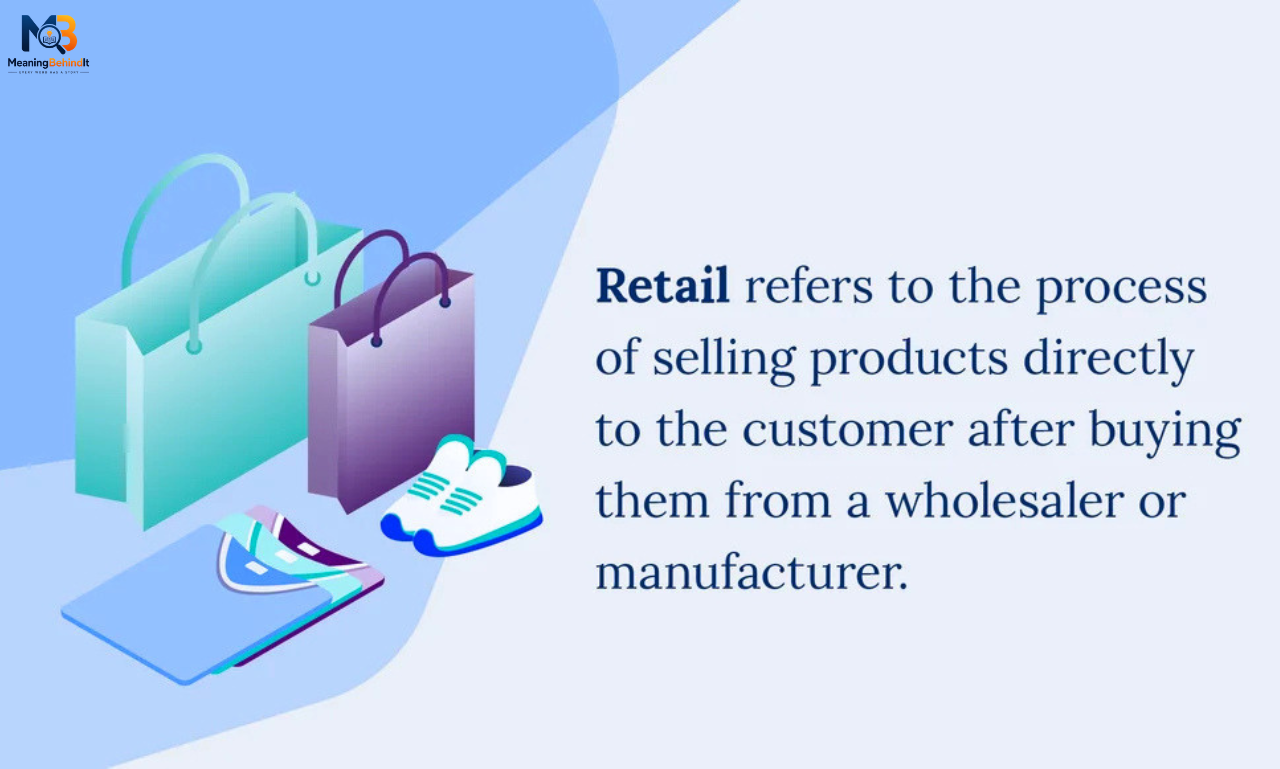
A retail price is the amount charged by a retailer to the end consumer for purchasing a product or service. It represents the final selling price after accounting for acquisition costs, business expenses, market conditions, and the retailer’s expected profit. Unlike wholesale prices, which are offered to businesses purchasing products in bulk, retail prices are intended for individual customers who buy products for personal use.
From a business perspective, retail pricing is much more than simply adding a fixed percentage to a product’s cost. Successful retailers carefully evaluate customer demand, seasonal trends, competitor pricing, brand reputation, and perceived product value before deciding on a final price. Luxury brands, for example, often charge significantly higher retail prices because customers associate premium pricing with superior quality and exclusivity. On the other hand, discount retailers focus on lower prices to attract price-sensitive shoppers and increase sales volume.
Retail price also changes over time depending on economic conditions. Inflation, supply chain disruptions, manufacturing costs, and consumer demand can all influence pricing decisions. This is why the same product may have different retail prices across various stores or change in price throughout the year.
How Does Retail Price Work?
Retail pricing follows a structured process that begins long before a product reaches store shelves. Every product starts with a production or acquisition cost, commonly known as the cost price. Manufacturers calculate the expenses involved in producing the item, including raw materials, labor, packaging, transportation, and overhead costs. Once the product is ready, it is sold to wholesalers or directly to retailers.
Retailers purchase these products at wholesale prices and then determine the appropriate markup. This markup covers business expenses such as rent, employee wages, marketing campaigns, payment processing fees, warehousing, insurance, and inventory management. In addition to covering operational costs, the markup also ensures that the retailer earns a profit from each sale. The combination of the product’s cost and the retailer’s markup creates the final retail price that customers see.
However, pricing decisions are rarely based on cost alone. Retailers also monitor competitors, analyze customer behavior, evaluate local market conditions, and consider the perceived value of their products. For example, two stores may purchase the same product at identical wholesale prices, yet one may sell it for a higher retail price because it offers a better shopping experience, stronger customer service, or a more recognizable brand image.
Modern retailers also rely heavily on technology to optimize pricing. Many online stores use dynamic pricing systems that automatically adjust prices based on demand, competitor pricing, inventory levels, and customer behavior. During peak shopping seasons or periods of limited supply, retail prices may increase, while discounts and promotions are commonly offered during slower sales periods to encourage purchases and clear inventory.
How Is Retail Price Calculated?
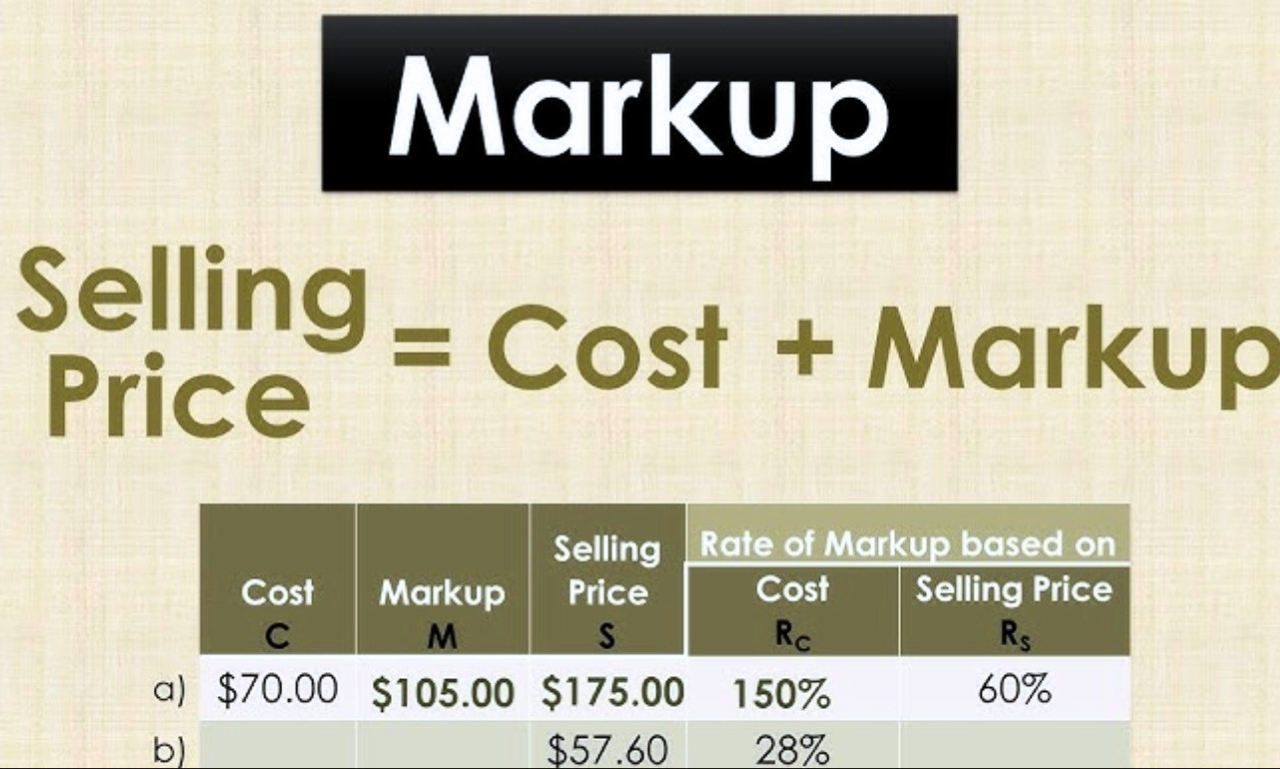
Although pricing strategies vary across industries, the basic concept behind retail pricing remains relatively simple. Retailers begin with the product’s cost and then add a markup that covers operating expenses and desired profit.
Basic Retail Price Formula
| Formula | Explanation |
| Retail Price = Cost Price + Markup | Most commonly used pricing formula |
Example 1
Imagine a retailer purchases a coffee maker from a supplier for $60. After analyzing operating expenses and profit goals, the retailer decides to apply a 40% markup.
| Item | Amount |
| Cost Price | $60 |
| Markup (40%) | $24 |
| Retail Price | $84 |
In this example, the customer pays $84, which allows the retailer to recover costs while earning a reasonable profit.
Example 2
A clothing boutique buys a jacket for $80 from a manufacturer. To cover business expenses and maintain profitability, the retailer applies a markup of 50%.
| Item | Amount |
| Cost Price | $80 |
| Markup | $40 |
| Retail Price | $120 |
Although these examples appear straightforward, experienced retailers often make additional pricing adjustments based on competitor analysis, customer demand, seasonal promotions, and brand positioning. This is why products with similar production costs can sometimes have significantly different retail prices in different stores.
Retail Price vs Wholesale Price
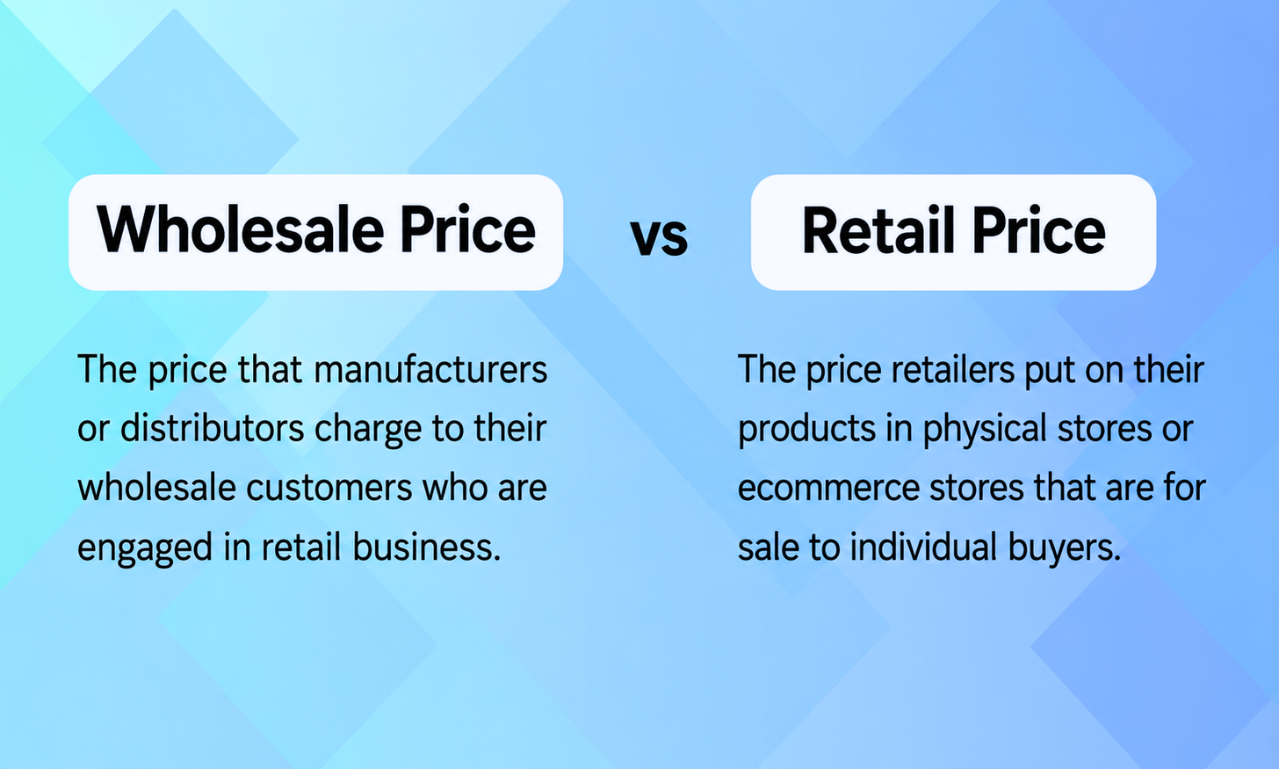
One of the most common questions people ask after learning the meaning retail price is how it differs from the wholesale price. Although both terms relate to product pricing, they serve entirely different purposes within the supply chain. Understanding this distinction is especially important for entrepreneurs, retailers, eCommerce sellers, and anyone planning to start a retail business.
The wholesale price is the amount manufacturers or distributors charge retailers when products are purchased in bulk. Since wholesalers sell large quantities rather than individual items, they offer products at significantly lower prices. Retailers then use these lower purchase costs as the foundation for determining their own retail prices. By adding an appropriate markup, retailers cover operating expenses and generate profit before offering products to consumers.
Retail price, on the other hand, is the final amount customers pay when buying a single product from a retail store or an online marketplace. Unlike wholesale pricing, retail pricing considers much more than the product’s acquisition cost. Retailers must account for rent, utilities, employee salaries, marketing expenses, packaging, payment processing fees, taxes, insurance, and many other operating costs. All of these factors influence the final price displayed to customers.
For example, imagine a smartphone accessory manufacturer sells phone cases to retailers for $8 each when purchased in bulk. A retailer then stocks those cases in their physical store, where they incur additional business costs such as staff wages, store maintenance, advertising, and inventory management. After calculating these expenses and adding a reasonable profit margin, the retailer sells the same phone case for $19.99. In this situation, $8 represents the wholesale price, while $19.99 is the retail price.
Retail Price vs Wholesale Price Comparison
| Feature | Retail Price | Wholesale Price |
| Buyer | Individual consumers | Retailers or businesses |
| Quantity | Usually single items | Bulk purchases |
| Price Level | Higher | Lower |
| Includes Markup | Yes | Usually minimal |
| Purpose | Final customer purchase | Business resale |
| Profit Source | Retailer’s profit | Manufacturer or wholesaler’s profit |
Although wholesale prices are generally lower, this does not mean retailers simply increase prices randomly. Successful businesses carefully analyze their costs, competitors, customer expectations, and market conditions before deciding on a retail price that remains competitive while supporting long-term profitability.
Retail Price vs Selling Price
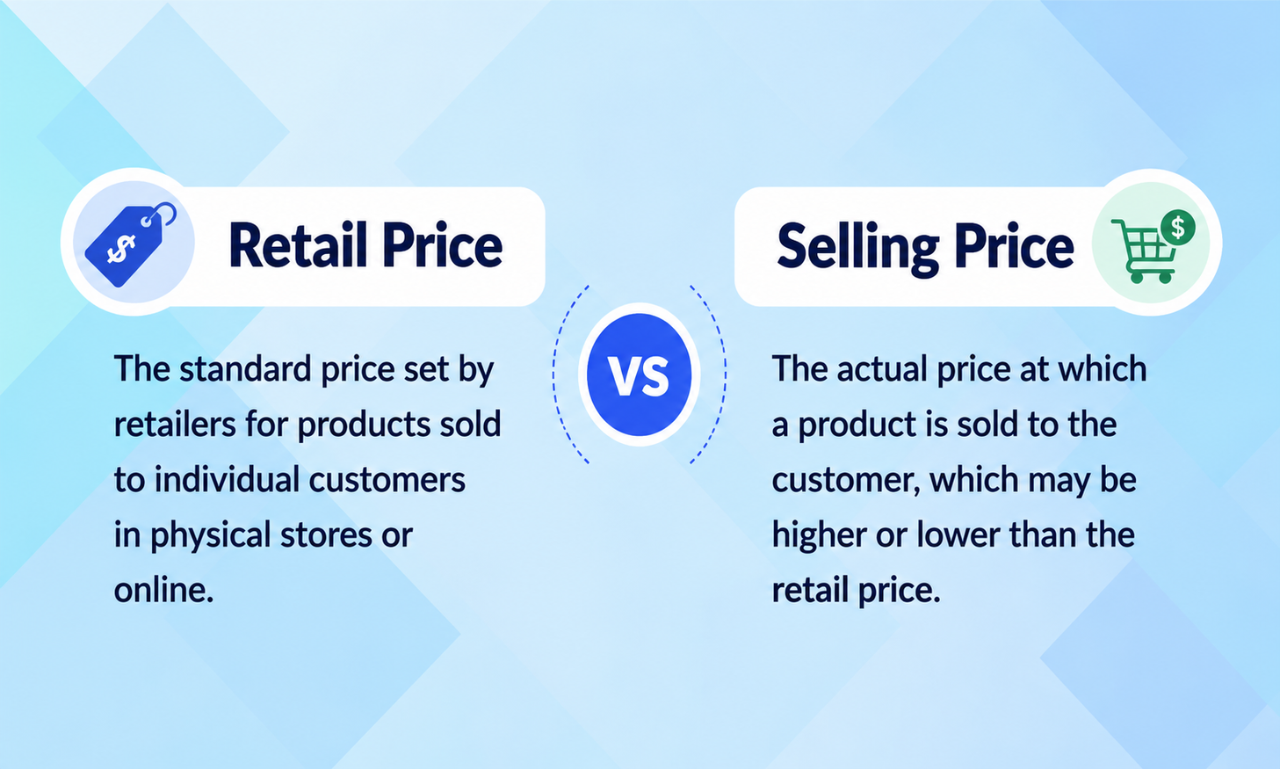
Many people mistakenly believe that retail price and selling price are exactly the same, but there can be important differences depending on how a product is sold. Understanding these differences helps both consumers and business owners interpret pricing more accurately.
Retail price refers to the standard price assigned to a product before any discounts or promotional offers are applied. It is the amount displayed on product shelves, online listings, or price tags. This price acts as the retailer’s recommended amount for the product under normal circumstances.
Selling price, however, represents the actual amount the customer pays after discounts, promotional campaigns, seasonal sales, loyalty rewards, or coupon codes have been applied. Because of this, the selling price is often lower than the retail price during promotional periods.
For example, a retailer may list a pair of running shoes with a retail price of $120. During a holiday sale, the store offers a 25% discount, reducing the amount customers actually pay to $90. In this example, $120 remains the retail price, while $90 becomes the selling price.
There are situations where the retail price and selling price are identical. This usually occurs when no discounts or special promotions are active. However, during events such as Black Friday, Cyber Monday, clearance sales, or end-of-season promotions, the selling price frequently differs from the original retail price.
Retail Price vs Selling Price
| Feature | Retail Price | Selling Price |
| Standard Listed Price | Yes | No |
| Final Customer Payment | Not always | Yes |
| Includes Discounts | No | Yes, if applicable |
| Changes Frequently | Less often | More often |
| Used for Promotions | Starting point | Final transaction value |
For retailers, distinguishing between these two prices is essential because promotional pricing strategies directly influence customer behavior, sales volume, and overall profitability.
Retail Price vs MSRP
Another pricing term that often creates confusion is MSRP, which stands for Manufacturer’s Suggested Retail Price. Although MSRP and retail price may appear similar, they are not always identical.
MSRP is the price recommended by the manufacturer. It serves as guidance for retailers when determining how much to charge consumers. Manufacturers calculate this suggested price after considering production costs, market conditions, and brand positioning. However, retailers are generally not required to sell products at the exact MSRP unless contractual agreements specify otherwise.
Retail price is determined by the retailer rather than the manufacturer. Store owners may choose to match the MSRP, charge a higher amount, or reduce prices below the suggested level depending on competition, inventory levels, customer demand, and promotional strategies.
For instance, a television manufacturer may recommend an MSRP of $799 for a new smart TV. One electronics retailer might sell it at the suggested price, another may offer it for $749 during a weekend promotion, while a premium retailer may charge $829 because of additional installation services or extended warranties. Although all three retailers are selling the same product, their retail prices differ despite sharing the same MSRP.
Retail Price vs MSRP
| Feature | Retail Price | MSRP |
| Set By | Retailer | Manufacturer |
| Mandatory | No | No |
| Can Change | Frequently | Usually fixed initially |
| Customer Pays | Yes | Not always |
| Used For | Final selling price | Pricing recommendation |
Understanding MSRP helps consumers recognize promotional offers and compare prices across multiple retailers before making purchasing decisions.
Factors That Affect Retail Price
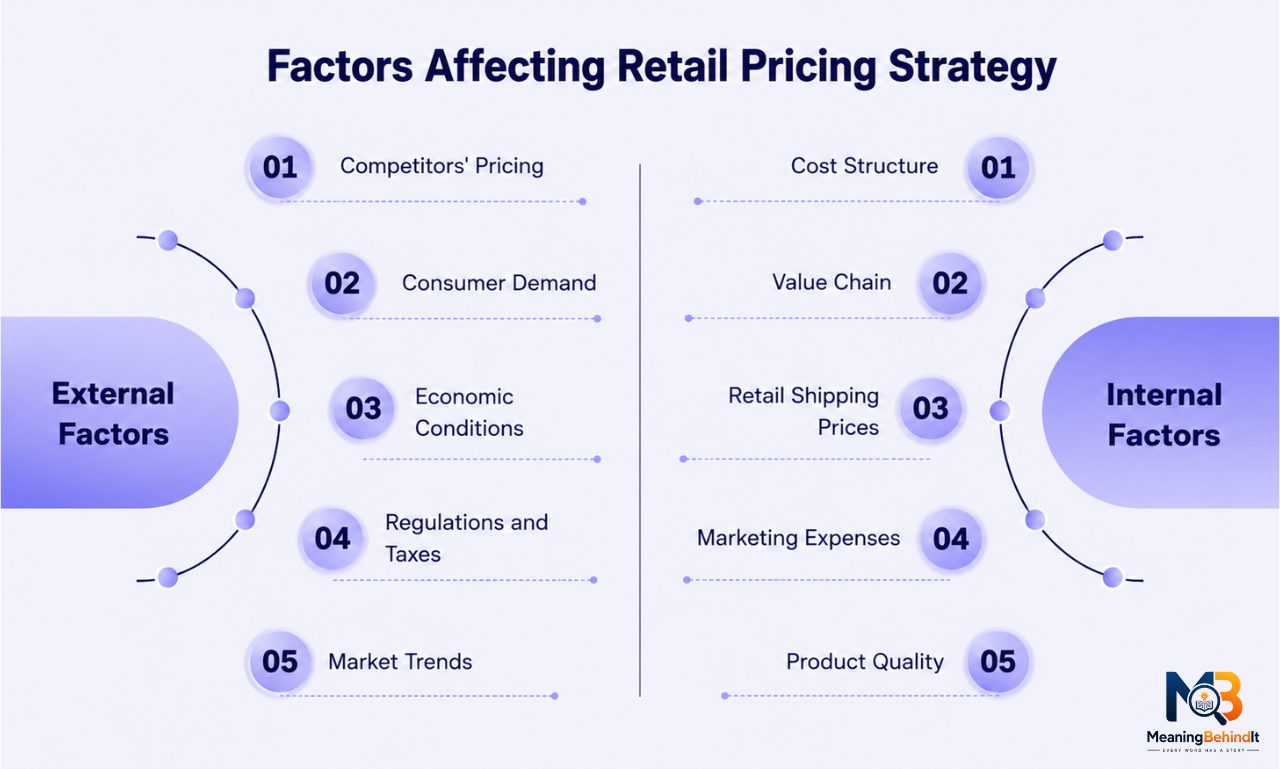
Retail pricing is influenced by much more than simply adding profit to a product’s cost. Businesses constantly evaluate both internal and external factors before deciding on a final retail price. A successful pricing strategy considers customer expectations, market competition, business expenses, and overall profitability.
Cost of Production
The most fundamental factor influencing retail price is the product’s production or acquisition cost. Manufacturers spend money on raw materials, labor, packaging, transportation, equipment, and quality control before products ever reach retailers. If these costs increase, retailers often have little choice but to raise their retail prices to maintain profit margins.
For example, rising fuel prices may increase transportation expenses, while shortages of raw materials can make manufacturing more expensive. These higher costs eventually affect the retail prices consumers see in stores.
Operating Expenses
Retail businesses incur numerous expenses beyond purchasing inventory. Rent, employee wages, electricity, software subscriptions, insurance, warehousing, marketing campaigns, and payment processing fees all contribute to operating costs. Retail prices must be high enough to cover these expenses while allowing businesses to remain profitable.
Even online stores face significant operational costs, including website maintenance, shipping, customer support, digital advertising, and return management. Although eCommerce businesses often avoid storefront expenses, they still need sustainable pricing strategies to remain competitive.
Market Demand
Customer demand plays a major role in determining retail prices. Products experiencing high demand often command higher prices because consumers are willing to pay more. Conversely, products with declining popularity frequently require discounts to encourage sales.
A good example is newly released gaming consoles or smartphones. During launch periods, limited availability and strong consumer demand often lead retailers to maintain higher retail prices. As supply increases over time, prices typically become more competitive.
Competition
Businesses constantly monitor competitor pricing before setting their own retail prices. Charging significantly more than competitors without offering additional value can reduce sales, while pricing products too low may unnecessarily reduce profit margins.
Competitive pricing does not always mean offering the lowest price. Many successful retailers justify slightly higher prices by providing exceptional customer service, faster delivery, extended warranties, or premium shopping experiences.
Brand Value
Brand reputation strongly influences customer perception of value. Well-established brands often charge premium retail prices because consumers associate them with higher quality, reliability, innovation, and trust.
Luxury fashion companies, premium electronics brands, and high-end cosmetic manufacturers frequently maintain higher retail prices than lesser-known competitors despite having similar production costs. Customers are often willing to pay extra because they value the brand’s reputation and perceived quality.
Seasonal Trends
Retail prices frequently fluctuate throughout the year based on seasonal demand. Holiday shopping periods, back-to-school seasons, summer vacations, and festive events create temporary increases in consumer demand. During these periods, retailers may adjust pricing to maximize revenue while still remaining competitive.
After seasonal demand declines, businesses often introduce discounts to reduce excess inventory and prepare for new product releases. This pricing cycle is common across industries such as fashion, electronics, home décor, and sporting goods.
Common Retail Pricing Strategies
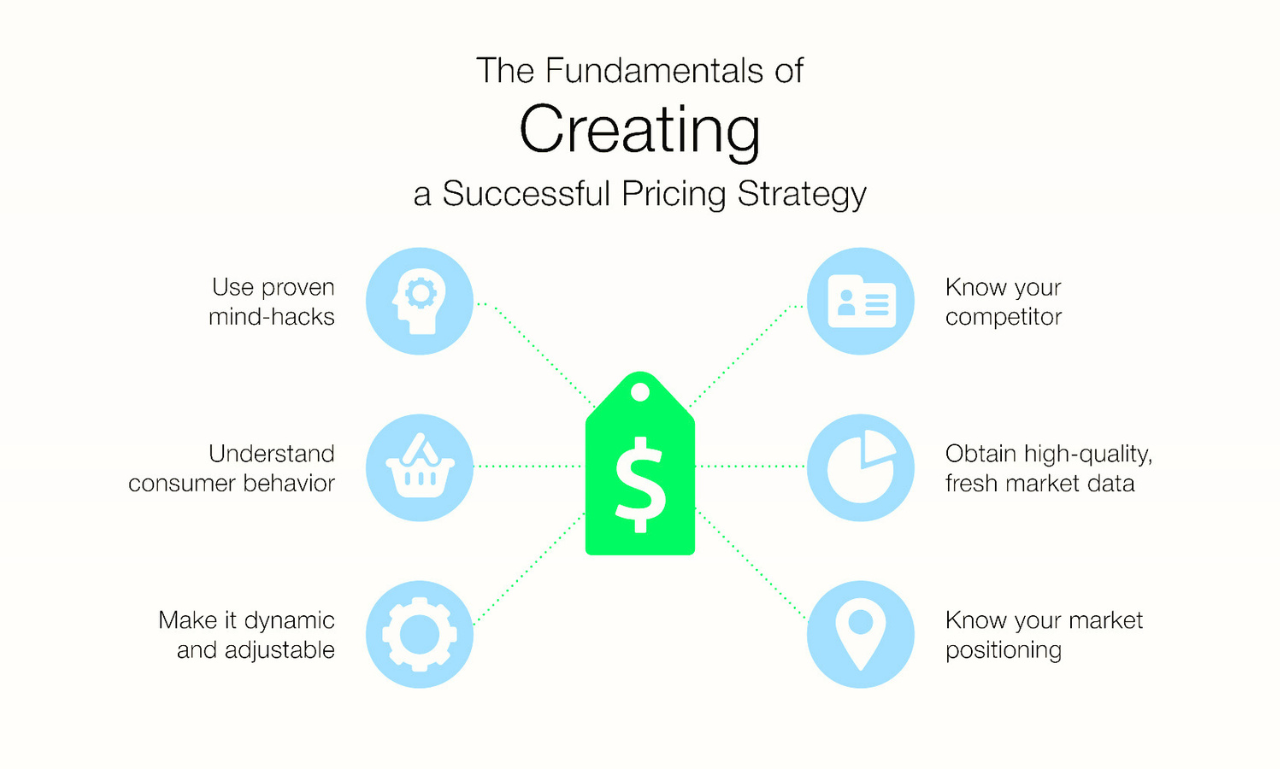
Setting the right retail price is one of the most important decisions any business can make. A pricing strategy is much more than choosing a number that covers costs and generates profit. It influences how customers perceive a brand, how products compete in the marketplace, and how successfully a business can achieve its long-term goals. Different businesses use different pricing strategies depending on their target audience, industry, competition, and overall business objectives.
Choosing the wrong pricing strategy can reduce profits, discourage potential customers, or even damage a company’s reputation. On the other hand, selecting the right approach allows retailers to attract buyers, increase customer loyalty, and maximize revenue while staying competitive. Below are some of the most widely used retail pricing strategies that businesses around the world rely on.
Cost-Plus Pricing
Cost-plus pricing is one of the simplest and most commonly used pricing methods, especially among small businesses and new retailers. Under this strategy, a retailer calculates the total cost of acquiring or producing a product and then adds a predetermined markup percentage to determine the final retail price.
For example, if a retailer purchases a backpack for $40 and wants a 50% markup, the final retail price becomes $60. This method is easy to calculate and helps ensure that every sale contributes to covering business expenses while generating profit. However, relying solely on cost-plus pricing may cause businesses to overlook important market factors such as customer demand and competitor pricing.
Cost-plus pricing works particularly well for businesses with stable operating costs and consistent product demand. Many independent retailers, gift shops, bookstores, and local boutiques use this strategy because of its simplicity and predictable profit margins.
Competitive Pricing
Competitive pricing focuses on market conditions rather than production costs alone. Businesses regularly analyze competitors’ prices and position their products accordingly. Some retailers intentionally price products slightly below competitors to attract more customers, while others match similar prices to remain competitive without reducing profit margins.
This strategy is especially common in highly competitive industries such as electronics, groceries, clothing, and consumer goods, where customers can easily compare prices between multiple retailers. Modern eCommerce platforms have made competitive pricing even more important because shoppers can compare products across dozens of websites within minutes.
Although competitive pricing helps businesses remain relevant in crowded markets, companies must avoid engaging in constant price wars. Continuously lowering prices simply to outperform competitors can reduce profitability and weaken long-term business sustainability.
Value-Based Pricing
Value-based pricing focuses on the perceived value of a product rather than its production cost. Instead of asking, “How much did this product cost to produce?” businesses ask, “How much are customers willing to pay based on the value they receive?”
This strategy is commonly used by premium brands that offer exceptional quality, innovative features, superior customer service, or strong brand recognition. Customers purchasing luxury watches, designer clothing, professional software, or premium skincare products often expect higher prices because they associate them with better quality and reliability.
Businesses using value-based pricing invest heavily in branding, customer experience, and product differentiation. As a result, customers are often willing to pay higher retail prices because they believe the product offers greater overall value than cheaper alternatives.
Psychological Pricing
Psychological pricing is designed to influence customer perception rather than simply reflect product costs. One of the most familiar examples is pricing products at $9.99 instead of $10.00. Although the actual difference is only one cent, many shoppers perceive the lower number as a significantly better deal.
Retailers also use strategies such as “Buy One, Get One Free,” limited-time offers, bundle discounts, and prices ending in .95 or .99 to encourage purchasing decisions. These techniques create a sense of urgency and make products appear more affordable, even when the actual savings are relatively small.
Psychological pricing is widely used by supermarkets, department stores, online retailers, and eCommerce platforms because it consistently influences consumer buying behavior.
Premium Pricing
Premium pricing is commonly adopted by brands that want to position themselves as high-quality or luxury providers. Rather than competing on affordability, these businesses intentionally maintain higher retail prices to reinforce the perception of exclusivity, superior craftsmanship, or advanced technology.
Luxury fashion brands, high-end automobiles, premium electronics, and designer accessories often rely on premium pricing. Customers purchasing these products are not simply buying functionality—they are also paying for reputation, prestige, customer experience, and emotional value.
While premium pricing can produce higher profit margins, it requires businesses to consistently deliver outstanding quality and maintain strong brand credibility. If customers feel that the product does not justify its price, trust can quickly decline.
Dynamic Pricing
Dynamic pricing allows retailers to adjust prices based on changing market conditions. Instead of keeping prices fixed, businesses modify them according to factors such as customer demand, inventory levels, competitor pricing, seasonal trends, and purchasing behavior.
Airlines, hotels, ride-sharing services, and many online retailers use dynamic pricing systems powered by artificial intelligence and data analytics. For example, hotel room prices often increase during holidays when demand is high and decrease during off-peak periods to attract more bookings.
Although dynamic pricing helps businesses maximize revenue, transparency remains important. Sudden or unexplained price increases can negatively affect customer trust if buyers feel they are being treated unfairly.
Real-Life Examples of Retail Price
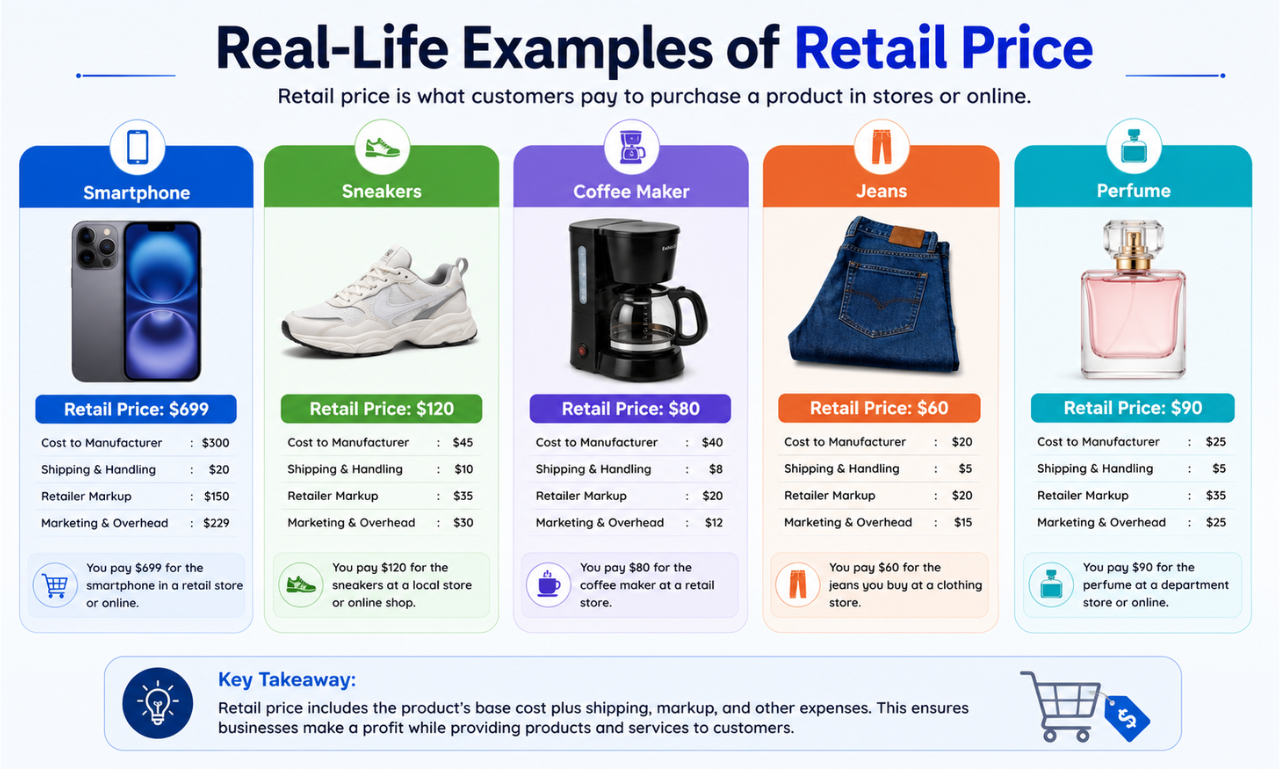
Understanding retail pricing becomes much easier when looking at practical examples from everyday shopping experiences. Almost every product we purchase follows the same basic pricing process, regardless of the industry.
Imagine a supermarket purchases a box of breakfast cereal from a wholesaler for $3.20. After accounting for transportation, shelf stocking, employee wages, electricity, and desired profit, the supermarket sells the cereal for $5.49. In this case, $5.49 is the retail price that customers pay at checkout.
The same principle applies in the fashion industry. A clothing retailer may purchase a jacket from a manufacturer for $55. After considering operational expenses, marketing costs, and profit objectives, the retailer offers the jacket to customers for $99. Seasonal promotions might temporarily reduce the selling price to $79, but the original retail price remains $99.
Online marketplaces also follow similar pricing models. An eCommerce business purchasing wireless earbuds for $25 may list them at $49.99 to cover shipping, payment processing fees, customer support, advertising expenses, and business profit. Although online retailers often have lower overhead costs than physical stores, they still rely on carefully calculated retail pricing strategies to remain profitable.
These examples demonstrate that retail pricing extends far beyond simply doubling a product’s cost. Successful businesses carefully evaluate multiple financial and market-related factors before deciding on a final selling price.
Why Retail Price Matters
Retail price affects nearly every aspect of a business. It influences purchasing decisions, shapes customer expectations, determines profitability, and plays a significant role in brand positioning. Even small pricing adjustments can dramatically impact sales volume and long-term business performance.
For consumers, retail price provides an immediate indication of affordability and value. Many buyers compare similar products across multiple stores before making purchasing decisions. A well-balanced retail price helps customers feel confident that they are receiving fair value for their money without compromising product quality.
From a business perspective, pricing directly affects profitability. Charging prices that are too low may increase sales volume but leave insufficient profit to cover operating expenses. On the other hand, prices that are excessively high can reduce customer demand and allow competitors to capture market share.
Retail pricing also influences inventory management. Products priced appropriately tend to sell at predictable rates, reducing storage costs and minimizing excess inventory. Poor pricing decisions often lead to unsold products, increased clearance sales, and lower overall profitability.
Finally, retail price contributes to brand identity. Luxury brands intentionally maintain premium prices to reinforce exclusivity, while discount retailers focus on affordability to attract cost-conscious shoppers. In both cases, pricing becomes an important part of how customers perceive the business.
Advantages of Retail Pricing
An effective retail pricing strategy offers several important advantages for both businesses and consumers. One of the greatest benefits is predictable profitability. When prices are carefully calculated, businesses can confidently cover operational expenses while generating sustainable profit margins that support future growth.
Retail pricing also provides flexibility. Businesses can adjust prices based on seasonal demand, inventory levels, competitor activity, or changing economic conditions without completely redesigning their business models. This adaptability allows retailers to respond quickly to market trends while remaining competitive.
Another advantage is improved customer trust. Transparent pricing helps customers understand what they are paying and reduces confusion during the purchasing process. Clear pricing policies often contribute to stronger customer satisfaction and increased brand loyalty.
Well-planned retail pricing also supports long-term business planning. Reliable pricing structures make it easier to forecast revenue, manage inventory, negotiate supplier agreements, and develop marketing strategies that align with financial objectives.
Disadvantages of Retail Pricing
Despite its many benefits, retail pricing also presents several challenges. One of the biggest difficulties is finding the right balance between competitiveness and profitability. Setting prices too high may discourage customers, while pricing products too low can significantly reduce profit margins.
Changing market conditions create additional challenges. Inflation, supply chain disruptions, rising transportation costs, and economic uncertainty often force retailers to adjust prices more frequently than they would prefer. These adjustments may sometimes lead to customer dissatisfaction if buyers perceive prices as unfair.
Retailers also face increasing pressure from online competitors that allow customers to compare prices instantly across multiple platforms. Businesses must continuously monitor competitors and market trends to ensure their prices remain attractive without sacrificing financial stability.
Finally, promotional pricing strategies can create unrealistic customer expectations. If businesses rely too heavily on discounts, customers may become reluctant to purchase products at regular retail prices, reducing long-term profitability.
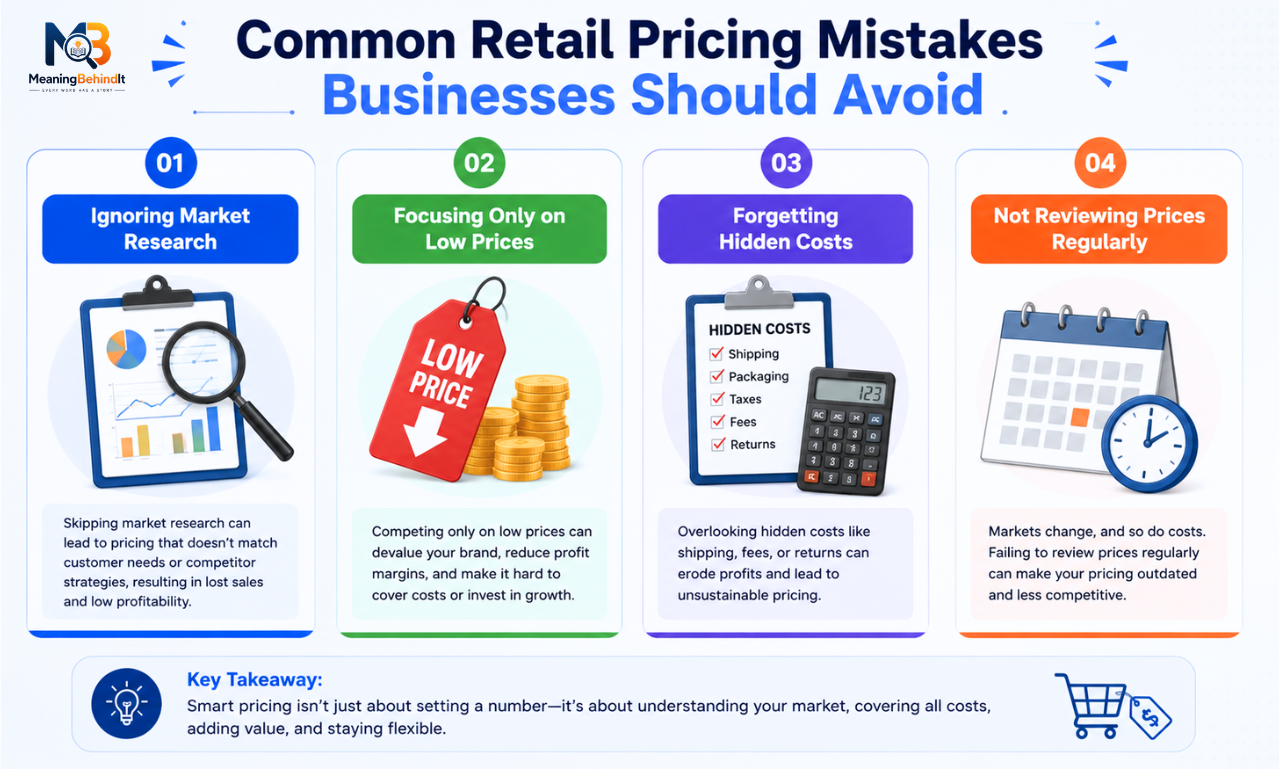
Common Retail Pricing Mistakes Businesses Should Avoid
Setting a retail price may seem straightforward, but many businesses make costly mistakes that negatively impact sales, customer trust, and overall profitability. Whether it’s a new startup or an established retailer, pricing errors can quickly reduce competitiveness in the market. Understanding these common mistakes can help business owners make more informed pricing decisions and create a sustainable pricing strategy.
Ignoring Market Research
One of the biggest mistakes retailers make is setting prices without researching the market. Some businesses focus only on their own costs while ignoring what competitors are charging or what customers are willing to pay. Even if a product is high quality, pricing it far above the market average without offering additional value can discourage potential buyers.
Successful retailers regularly analyze competitor pricing, customer preferences, and industry trends before adjusting their prices. Market research provides valuable insights that help businesses remain competitive while maintaining healthy profit margins.
Focusing Only on Low Prices
Many businesses believe that offering the lowest prices will automatically attract more customers. While affordable pricing can increase sales volume, constantly underpricing products often reduces profitability and may even create doubts about product quality.
Customers don’t always choose the cheapest option. Many are willing to pay more for better service, trusted brands, faster delivery, higher quality, or stronger warranties. Instead of competing only on price, retailers should focus on delivering overall value.
Forgetting Hidden Costs
Another common pricing mistake is overlooking operational expenses. Some retailers calculate prices based only on the product’s purchase cost and forget to include expenses such as shipping, packaging, employee salaries, rent, software subscriptions, marketing, taxes, insurance, and payment processing fees.
Ignoring these hidden costs can significantly reduce profit margins, even if sales remain strong. A well-planned retail pricing strategy should account for every expense associated with selling the product.
Not Reviewing Prices Regularly
Retail pricing should never remain completely static. Market conditions, supplier costs, inflation, customer demand, and competitor pricing continuously change. Businesses that fail to review their prices regularly risk losing customers or reducing profits unnecessarily.
Successful retailers periodically evaluate pricing performance and make adjustments when necessary. This proactive approach helps businesses remain competitive while protecting long-term profitability.
Tips for Setting the Right Retail Price
Determining the right retail price requires balancing profitability with customer expectations. While there is no universal formula that works for every business, following proven pricing principles can significantly improve decision-making.
First, calculate the true cost of selling the product. This includes not only the purchase or manufacturing cost but also every operational expense associated with getting the product into the customer’s hands. Understanding total costs provides a reliable foundation for pricing decisions.
Next, research competitors carefully. Comparing prices across multiple retailers helps businesses understand current market expectations. However, competitors should not be copied blindly. Instead, retailers should identify opportunities to differentiate themselves through better service, stronger branding, or additional customer benefits.
Understanding the target audience is equally important. Customers shopping for luxury products often prioritize quality and brand reputation over low prices, while budget-conscious shoppers focus on affordability. Knowing your audience helps determine whether premium, competitive, or value-based pricing is the best approach.
Retailers should also test pricing strategies whenever possible. Small pricing adjustments can reveal valuable insights about customer behavior without significantly increasing business risk. Many successful online retailers conduct A/B pricing tests to determine which price points generate the highest overall revenue.
Finally, pricing decisions should remain flexible. Markets change continuously, and businesses that regularly review pricing data are better positioned to respond to economic conditions, seasonal trends, and changing customer expectations.
Frequently Asked Questions (FAQs)
What is the meaning of retail price?
Retail price is the final amount a consumer pays when purchasing a product from a retailer. It includes the product’s cost, business operating expenses, and the retailer’s profit margin. The retail price is the amount displayed on product labels, shelves, or online listings before any discounts or promotional offers are applied.
Is retail price the same as selling price?
Not always. Retail price is the standard listed price of a product, while the selling price is the actual amount a customer pays after discounts, coupons, or promotional offers. During regular sales periods, both prices may be the same, but during promotions the selling price is usually lower.
What is the difference between retail price and wholesale price?
Wholesale price is the amount retailers pay suppliers or manufacturers when purchasing products in bulk. Retail price is the higher amount charged to individual customers after adding operating costs and profit margins. The difference between the two prices allows retailers to earn revenue from product sales.
How do retailers calculate retail price?
Retailers typically begin with the product’s acquisition cost and then add a markup to cover operating expenses and generate profit. However, they also consider competitor pricing, customer demand, brand positioning, and market conditions before deciding on the final retail price.
Why is retail price important?
Retail price directly affects customer purchasing decisions, business profitability, inventory management, and brand positioning. Setting the right price helps businesses remain competitive while ensuring they earn enough revenue to support long-term growth.
Can two stores sell the same product at different retail prices?
Yes. Different retailers often have different operating expenses, marketing strategies, customer service levels, and profit goals. As a result, the same product may have different retail prices across multiple stores without affecting its quality.
What factors influence retail price?
Several factors influence retail pricing, including production costs, transportation expenses, operating costs, customer demand, competitor pricing, seasonal trends, inflation, and brand reputation. Businesses evaluate these factors before determining the final price.
What is a good retail pricing strategy?
There is no single strategy that works for every business. Cost-plus pricing, competitive pricing, value-based pricing, premium pricing, and psychological pricing are among the most common approaches. The best strategy depends on the product, target audience, competition, and business objectives.
Does a higher retail price always mean better quality?
Not necessarily. While premium brands often charge higher prices because of quality and reputation, price alone does not guarantee superior performance. Consumers should consider product features, customer reviews, warranties, and brand credibility before making purchasing decisions.
Can retail prices change over time?
Yes. Retail prices frequently change because of inflation, supplier costs, seasonal demand, competitor pricing, inventory levels, and economic conditions. Businesses regularly review pricing strategies to remain competitive in changing markets.
Conclusion
Understanding the meaning retail price is essential for both consumers and businesses because it explains how products are priced before they reach the final buyer. While many people simply view retail price as the number printed on a price tag, it actually represents a carefully planned balance between product costs, operating expenses, market demand, competition, and expected profit. Every pricing decision plays an important role in determining whether a business can remain competitive while continuing to grow.
For consumers, knowing how retail prices are determined makes it easier to compare products, recognize genuine discounts, and make smarter purchasing decisions. For retailers and entrepreneurs, effective pricing is one of the strongest tools for increasing profitability, strengthening brand value, and building long-term customer trust. Businesses that regularly evaluate their pricing strategies, understand market conditions, and focus on delivering value are more likely to succeed in today’s competitive retail environment.
Whether you’re managing a physical store, operating an online business, or simply trying to understand pricing terminology, mastering the concept of retail price provides valuable insight into how modern commerce works. By applying the principles discussed in this guide, you’ll be better equipped to evaluate pricing decisions and understand the factors that influence the cost of products you buy or sell every day.
Read more about Meaning Retail Price: Complete Guide & Easy Examples (2026)

Saad is the founder and lead writer at MeaningBehindIt.com. He specializes in internet slang, text abbreviations, social media meanings, and digital communication, creating clear and accurate content that helps readers understand modern online language.